St. Benedict of Nursia
The father of Western monasticism whose balanced Rule formed communities of prayer, work, hospitality, obedience, and peace.
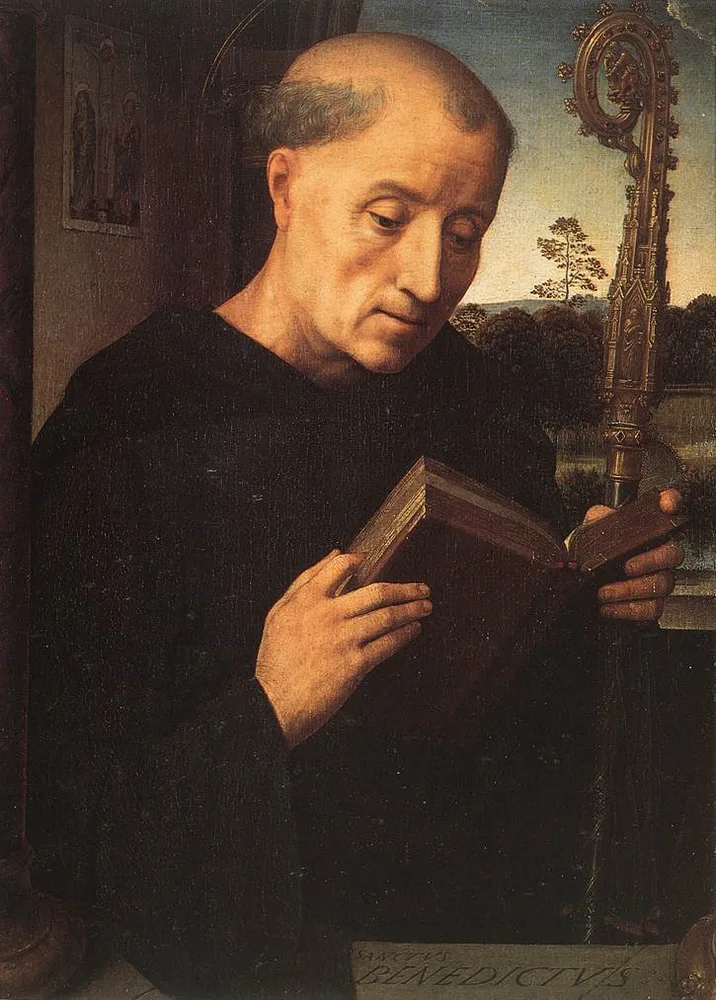
Image: Hans Memling — Public domain. Source and rights

Feast: July 11
Patronage and associations: Europe, Monks and religious communities, Students, People seeking protection from evil
Historical period: Early medieval Italy (c. 480–c. 547)
The Memorial of St. Benedict, Abbot, is celebrated on July 11 in the General Roman Calendar; in Europe he is honored as a patronal feast.
Quick facts
- Born
- c. 480, Nursia, Italy
- Died
- c. 547, Monte Cassino, Italy
- Vocation
- Abbot and monastic founder
- Major work
- The Rule of St. Benedict
- Named Patron of Europe
- 1964, by Pope Paul VI
Who Was St. Benedict of Nursia?
St. Benedict was born around 480 in Nursia, now Norcia, Italy. The principal ancient account of his life is Book Two of Pope St. Gregory the Great’s Dialogues. Gregory wrote to teach through the example of a holy man, not to produce a modern critical biography. That means the broad outline is historically important while individual miracle stories should be read in their hagiographic purpose.
Benedict was sent to Rome for education but became troubled by the moral disorder he encountered. He withdrew first to a small community and then to solitude near Subiaco. His years as a hermit were not an escape from responsibility forever. Other people sought his guidance, and communities gathered around him. After conflict with one group, he established monasteries in the region and later founded the monastery at Monte Cassino.
Benedict’s lasting gift is his Rule for monastic communities. It draws on earlier Christian monastic tradition and presents a practical school of service to the Lord. The Rule orders common prayer, reading, manual work, sleep, meals, correction, leadership, and care for the sick. It is demanding but marked by moderation. The abbot must listen, adapt discipline to different people, and remember that he will answer to God for those entrusted to him.
Hospitality receives special attention: guests are to be welcomed as Christ. Work and prayer are not competing activities. The monk learns to seek God through the daily rhythm of worship, responsibility, silence, relationships, and obedience. Benedict did not use “ora et labora” as a slogan in the Rule, but the phrase accurately captures the tradition’s integration of prayer and work.
Benedict died at Monte Cassino around 547. Communities following his Rule helped preserve learning, evangelize, serve travelers and the poor, and shape Christian culture across Europe. Pope Paul VI named him a patron of Europe in 1964. Benedict’s wisdom is useful beyond monasteries. Families, workplaces, and parishes also need stable rhythms, patient leadership, careful listening, and room for God. His life teaches that holiness is built less by constant novelty than by faithful practices repeated with love. Stability gives charity time to become more than a passing intention.
What St. Benedict of Nursia Teaches Us Today
1. A stable rhythm protects what matters
Regular times for prayer, work, rest, and community help faith survive changing moods.
2. Leadership begins by listening
Benedict expects leaders to hear counsel, know their people, and exercise authority as a responsibility before God.
3. Welcome Christ in the person before you
Hospitality turns ordinary attention to guests, strangers, and the vulnerable into an encounter with Jesus.
A Prayer Asking for St. Benedict’s Intercession
God of peace and order, you guided St. Benedict to build communities centered on prayer, work, and charity. Through his intercession, help me establish a faithful rhythm of life, listen before acting, and welcome others as I would welcome Christ. Protect me from temptation and from habits that scatter my attention. St. Benedict, pray for families, religious communities, students, and leaders, that our daily responsibilities may become a steady path toward God. Amen.
Original prayer written by Catholic Explained.