St. Faustina Kowalska
A Polish religious sister whose Diary helped spread devotion to the merciful love of Jesus and the call to trust God and practice mercy.
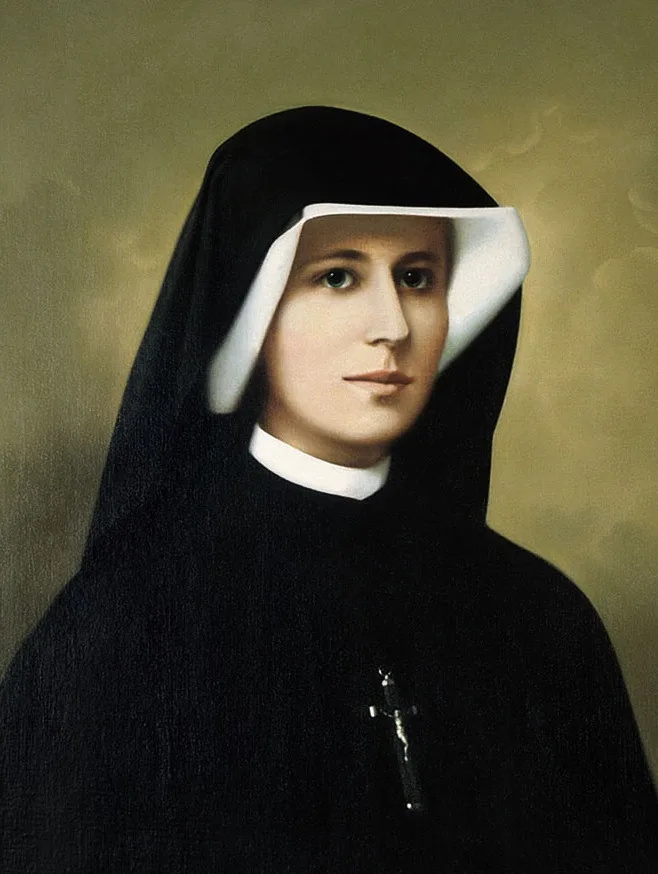
Image: Stanisław Sztama — Public domain. Source and rights

Feast: October 5
Patronage and associations: Devotion to Divine Mercy, People seeking God’s mercy, Poland
Historical period: Modern Poland (1905–1938)
St. Faustina’s optional memorial was added to the General Roman Calendar in 2020 and is celebrated on October 5.
Quick facts
- Born
- August 25, 1905, Głogowiec, Poland
- Died
- October 5, 1938, Kraków, Poland
- Birth name
- Helena Kowalska
- Religious family
- Congregation of the Sisters of Our Lady of Mercy
- Canonized
- April 30, 2000, by St. John Paul II
Who Was St. Faustina Kowalska?
St. Faustina was born Helena Kowalska in 1905 to a poor farming family in Poland. She received limited formal education and worked as a domestic servant while helping support her family. Helena believed she was called to religious life, but her parents initially refused permission. After a period of delay and inner struggle, she entered the Congregation of the Sisters of Our Lady of Mercy in Warsaw in 1925 and received the name Sister Maria Faustina.
Faustina’s convent responsibilities were ordinary: cooking, gardening, and serving at the door. Her public importance came through an interior spiritual mission. She reported encounters with Jesus centered on God’s mercy and kept a Diary at the direction of her confessors. Private revelations do not add to the Gospel, and Catholics are not required to treat them as new doctrine. The Church’s approval means the devotion can be practiced safely because its message agrees with the faith.
The Divine Mercy message emphasizes trust in Jesus and concrete mercy toward other people. Devotional practices associated with Faustina include the Divine Mercy image, the Chaplet of Divine Mercy, prayer at the hour of Christ’s death, and the Feast of Divine Mercy. These practices are not spiritual techniques that force God to act. They direct Christians to the mercy revealed fully in the death and resurrection of Jesus.
Faustina worked with her confessor, Blessed Michał Sopoćko, to communicate the message responsibly. She also experienced misunderstanding, illness, and periods of spiritual darkness. Tuberculosis weakened her, and she died in Kraków on October 5, 1938, at age thirty-three. St. John Paul II canonized her in 2000 and established Divine Mercy Sunday for the universal Church. Her optional memorial was added to the General Roman Calendar in 2020.
Faustina’s popularity can sometimes lead people to focus on extraordinary visions while overlooking the difficult daily work of trust. Her Diary repeatedly connects receiving mercy with showing mercy through action, word, and prayer. Her life reminds Catholics who are ashamed of sin that Christ’s mercy is greater, while also reminding the devout that mercy received must become patience, forgiveness, and service. Devotion is genuine when another person encounters mercy through us.
What St. Faustina Kowalska Teaches Us Today
1. God’s mercy is received, not earned
Trust begins by bringing sin and weakness honestly to Jesus rather than trying to make ourselves worthy first.
2. Private revelation serves the Gospel
Devotions should lead back to Christ, Scripture, the sacraments, and the faith already entrusted to the Church.
3. Mercy must become practical
Prayer to Divine Mercy should form merciful speech, patient action, forgiveness, and care for another person’s need.
A Prayer Asking for St. Faustina’s Intercession
Jesus, source of mercy, you taught St. Faustina to trust your love and make mercy visible to others. Through her intercession, help me bring my sins to you without despair and receive forgiveness with gratitude. Free me from harsh judgment, resentment, and indifference. Teach me to practice mercy in action, in speech, and in prayer. St. Faustina, pray that I may trust Jesus more deeply and lead others toward his merciful heart. Amen.
Original prayer written by Catholic Explained.