St. Monica
A North African wife and mother remembered for patient faith, persistent prayer, and her loving influence on St. Augustine’s conversion.
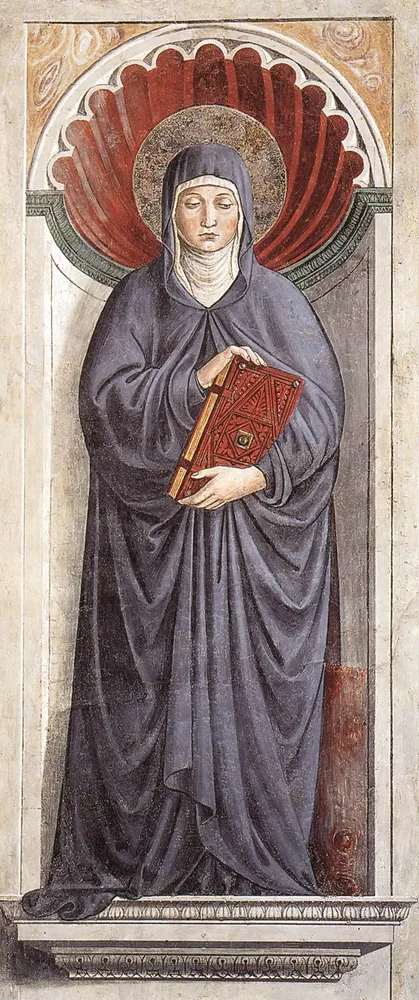
Image: Benozzo Gozzoli — Public domain. Source and rights

Feast: August 27
Patronage and associations: Mothers, Married women, Difficult family relationships, Family members away from the faith
Historical period: Late Roman North Africa (c. 331–387)
The Memorial of St. Monica is celebrated on August 27 in the General Roman Calendar, one day before St. Augustine.
Quick facts
- Born
- c. 331, Tagaste, North Africa
- Died
- 387, Ostia, Italy
- Family
- Mother of St. Augustine of Hippo
- Primary source
- St. Augustine’s Confessions
- Known for
- Faithful prayer, maternal love, and perseverance
Who Was St. Monica?
St. Monica was born in Tagaste in Roman North Africa, in what is now Algeria, around 331. Much of what we know comes from her son Augustine’s Confessions. Because he wrote with love and gratitude after her death, the book gives us something more personal than a list of dates: it shows a woman whose faith shaped a household through patience, tears, honest correction, and prayer.
Monica married Patricius, who was not a Christian when they married. Augustine describes a home that could be tense, and he praises his mother’s prudence and self-control. Patricius eventually received baptism before his death. Monica and Patricius had several children, but Augustine caused her the greatest concern. As a young man he rejected the Catholic faith she had taught him, joined the Manichaean movement, pursued ambition, and built a life far from the path she hoped he would follow.
Monica did not control Augustine into conversion. She prayed, spoke truth, sought guidance, and remained close enough to love him. At times that meant setting boundaries; at other times it meant following his journey from North Africa to Italy. In Milan she found support in Bishop Ambrose. Augustine was gradually led through intellectual struggle, Scripture, preaching, friendship, and grace. He was baptized by Ambrose at the Easter Vigil in 387.
Soon afterward, Monica and Augustine shared a profound conversation at Ostia about eternal life. Monica told him that her deepest earthly hope had been fulfilled: she had seen him become a Catholic Christian. She became ill and died there before the family could return to Africa. Augustine’s account of her death is tender but not sentimental. He grieved, prayed for her, and entrusted her to God’s mercy.
Monica is often invoked by parents worried about children who have left the faith. Her example is not a formula that guarantees another person’s conversion. Grace respects freedom, and every story unfolds differently. Monica shows parents how to love without surrendering hope, how to speak without constant pressure, and how to place an adult child in God’s hands while continuing to grow in their own holiness. Her perseverance asks parents to trust God’s timing rather than treating every conversation as a final test.
What St. Monica Teaches Us Today
1. Love cannot force conversion
Monica prayed and spoke faithfully, but Augustine still had to respond freely to grace.
2. Perseverance includes wise boundaries
Patient love is not passive. It can include honest correction, counsel, restraint, and respect for another person’s freedom.
3. Entrust the person, not just the outcome
Monica’s prayer grew from love for Augustine himself, not merely from a desire to win an argument.
A Prayer Asking for St. Monica’s Intercession
Faithful God, you heard St. Monica as she prayed for her family and entrusted her son to your mercy. Through her intercession, give me patient love for the people I cannot control. Help me speak the truth without fear, set wise boundaries without bitterness, and keep praying without treating another person’s freedom as a problem to solve. St. Monica, pray for families divided by belief and for everyone who longs to see someone they love return to Christ. Amen.
Original prayer written by Catholic Explained.