St. Thomas Aquinas
A Dominican priest and Doctor of the Church who united rigorous study, humble prayer, and deep love for Christ in the Eucharist.
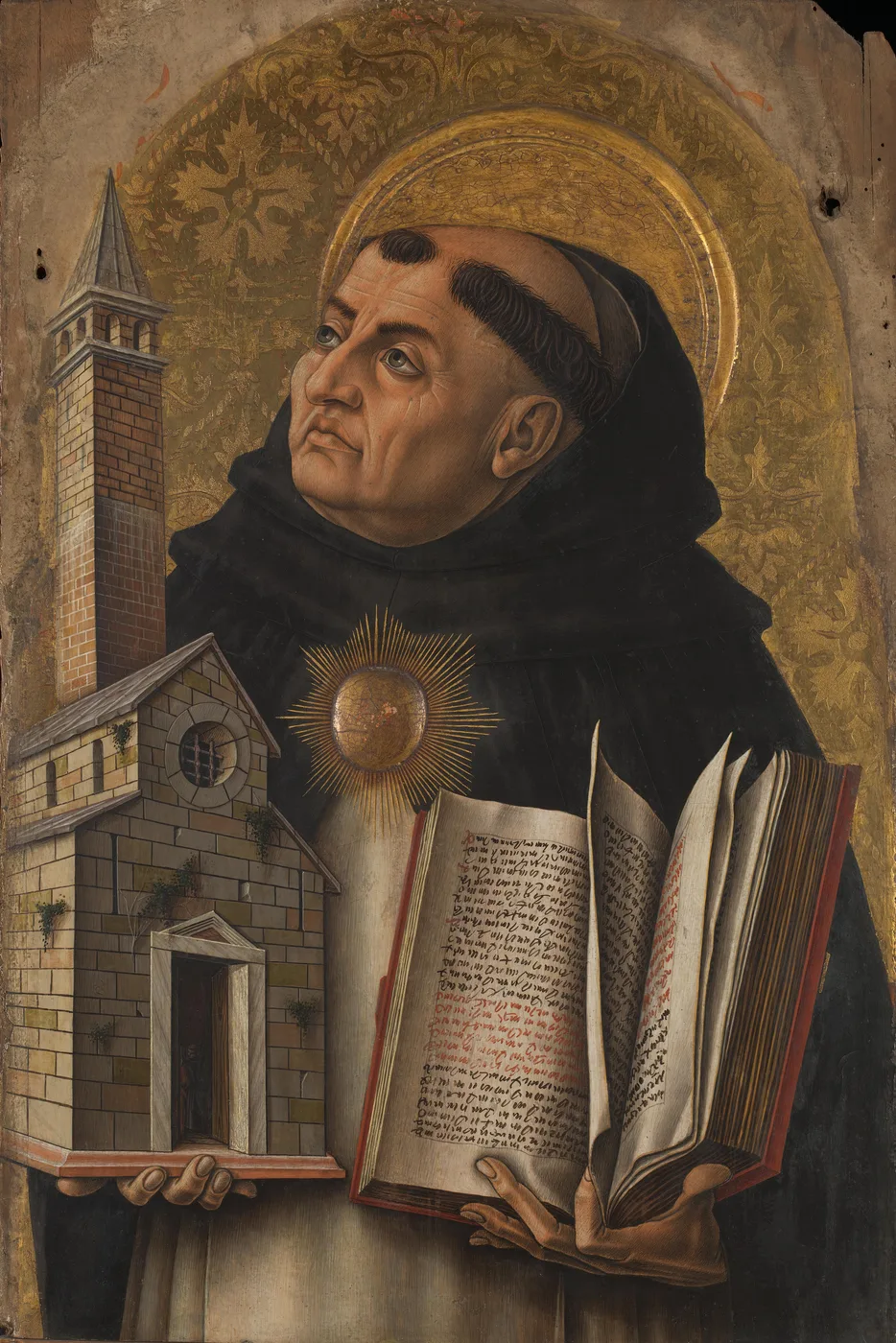
Image: Carlo Crivelli — Public domain. Source and rights

Feast: January 28
Patronage and associations: Students and universities, Catholic schools, Theologians and philosophers, Booksellers and publishers
Historical period: High medieval Europe (1224/25–1274)
The Memorial of St. Thomas Aquinas, Priest and Doctor of the Church, is celebrated on January 28 in the General Roman Calendar.
Quick facts
- Born
- 1224 or 1225, Roccasecca, Italy
- Died
- March 7, 1274, Fossanova, Italy
- Vocation
- Dominican priest and Doctor of the Church
- Major work
- Summa Theologiae
- Canonized
- July 18, 1323, by Pope John XXII
Who Was St. Thomas Aquinas?
St. Thomas Aquinas was born around 1225 near Roccasecca in southern Italy. His family expected him to pursue an influential church career, and he received early education at the Benedictine abbey of Monte Cassino before studying at Naples. There Thomas encountered the recently founded Dominican Order. He was drawn to its combination of prayer, study, poverty, and preaching, but his family strongly opposed his decision to join.
His relatives detained him for more than a year in an effort to change his mind. Thomas remained committed and eventually continued his Dominican formation. He studied under St. Albert the Great and later taught in Paris and several Italian cities. Because he was quiet and physically large, classmates reportedly underestimated him. His teachers recognized a powerful mind that could organize difficult questions with unusual clarity.
Thomas believed faith and reason come from the same God and therefore cannot truly contradict each other. Philosophy can discover genuine truths about creation, while revelation gives truths human reason could not reach on its own. His Summa Theologiae presents Christian teaching through carefully framed questions, objections, responses, and replies. Although famous for intellectual precision, Thomas understood theology as wisdom ordered toward knowing and loving God.
He also had a profound Eucharistic devotion. Pope Urban IV asked him to prepare texts for the feast of Corpus Christi, and hymns associated with that office remain part of Catholic worship. Near the end of his life, Thomas experienced something in prayer that led him to stop writing. He did not reject his previous work; he recognized how limited even the best human words remain before God’s reality.
Thomas died in 1274 while traveling to the Second Council of Lyon. He was canonized in 1323 and declared a Doctor of the Church in 1567. Students sometimes invoke him as though intelligence alone were his gift. His greater witness is the union of study and holiness. He researched carefully, listened to objections fairly, prayed, and submitted his work to the Church. He teaches that learning becomes Christian when truth leads to humility, worship, and service. His method remains a model for serious Catholic disagreement.
What St. Thomas Aquinas Teaches Us Today
1. Faith does not fear reason
Honest questions and careful study can serve faith because all truth ultimately comes from God.
2. Understand an objection before answering
Thomas stated opposing arguments seriously, teaching Catholics not to defeat a caricature of another person’s view.
3. Knowledge should end in worship
Study reaches its purpose when truth produces humility, love of God, and service rather than pride.
A Prayer Asking for St. Thomas Aquinas’s Intercession
God of wisdom, you gave St. Thomas Aquinas a brilliant mind and a humble love for Christ. Through his intercession, help me study patiently, judge fairly, and seek truth without pride. Give students perseverance, teachers integrity, and every Catholic courage to ask honest questions. Keep knowledge from becoming an idol, and let everything I learn lead me toward worship, charity, and clearer service of the Gospel. St. Thomas Aquinas, pray for us. Amen.
Original prayer written by Catholic Explained.